
How to Plan a Low-Maintenance Garden Makeover
A low-maintenance garden should save time without feeling empty or entirely covered in paving. The aim is to create an attractive, usable space in which each surface, plant and feature has a clear purpose. When planning a low-maintenance garden makeover in Lucan or nearby parts of west Dublin and north-east Kildare, good design decisions at the beginning can substantially reduce future work.
There is no completely maintenance-free garden. Paving requires cleaning, gravel needs occasional raking, artificial grass needs brushing and plants still require some care. The sensible goal is to remove repetitive or difficult tasks while retaining the comfort and character of a real outdoor space.
Identify which jobs you want to reduce
Different homeowners mean different things by low maintenance. One person may dislike mowing, while another wants to avoid regular hedge cutting or weeding between paving joints. Begin by listing the tasks that take the most time or are becoming physically difficult.
Common concerns include an oversized lawn, fast-growing hedges, narrow borders that are awkward to weed, damaged paving, poor drainage and plants that have outgrown their positions. The new garden can then be planned to address those specific issues rather than applying a generic solution.
It is also worth considering how the garden may be used in several years. Wider paths, fewer abrupt level changes and raised planting areas can make maintenance more manageable over time.
Create a simple, efficient layout
Complicated layouts often create more edges, joints and small areas that need attention. Simple shapes are usually easier to build, clean and maintain. A clearly defined patio, lawn and planting zone can still look distinctive when the proportions and materials are carefully chosen.
Avoid leaving very narrow strips of grass beside fences or paving. They are difficult to reach with a mower and quickly become untidy. Generous borders are easier to plant effectively than thin beds in which soil dries rapidly and plants have little room to grow.
Good access also reduces work. Paths should lead naturally to sheds, bins, gates and seating areas. If garden equipment has a designated storage location, routine upkeep becomes faster and the main space remains uncluttered.
Choose paving that can be maintained properly
Increasing the paved area can reduce lawn and planting work, but the surface still needs correct installation. A suitable foundation, stable edges, appropriate falls and effective drainage are essential in Irish weather. Poorly laid paving may hold water, move or develop persistent weed growth around failed joints.
Porcelain is popular for contemporary gardens because it offers a consistent finish and low water absorption. Natural stone has individual variation and can suit both modern and traditional homes, although the care requirements depend on the particular stone. Whichever material is chosen, it should have an appropriate external finish and be installed for safe use when wet.
Do not pave every available area solely to reduce maintenance. Some planted ground helps absorb rainfall and softens the appearance of boundaries and buildings. A balanced plan often performs better and feels more comfortable.
Select manageable lawn options
A smaller, well-shaped lawn is usually easier to look after than a large lawn with tight corners and obstacles. Natural turf offers a comfortable surface for children, pets and general use. It requires mowing and seasonal care, but good ground preparation and simple edging can make those tasks more straightforward.
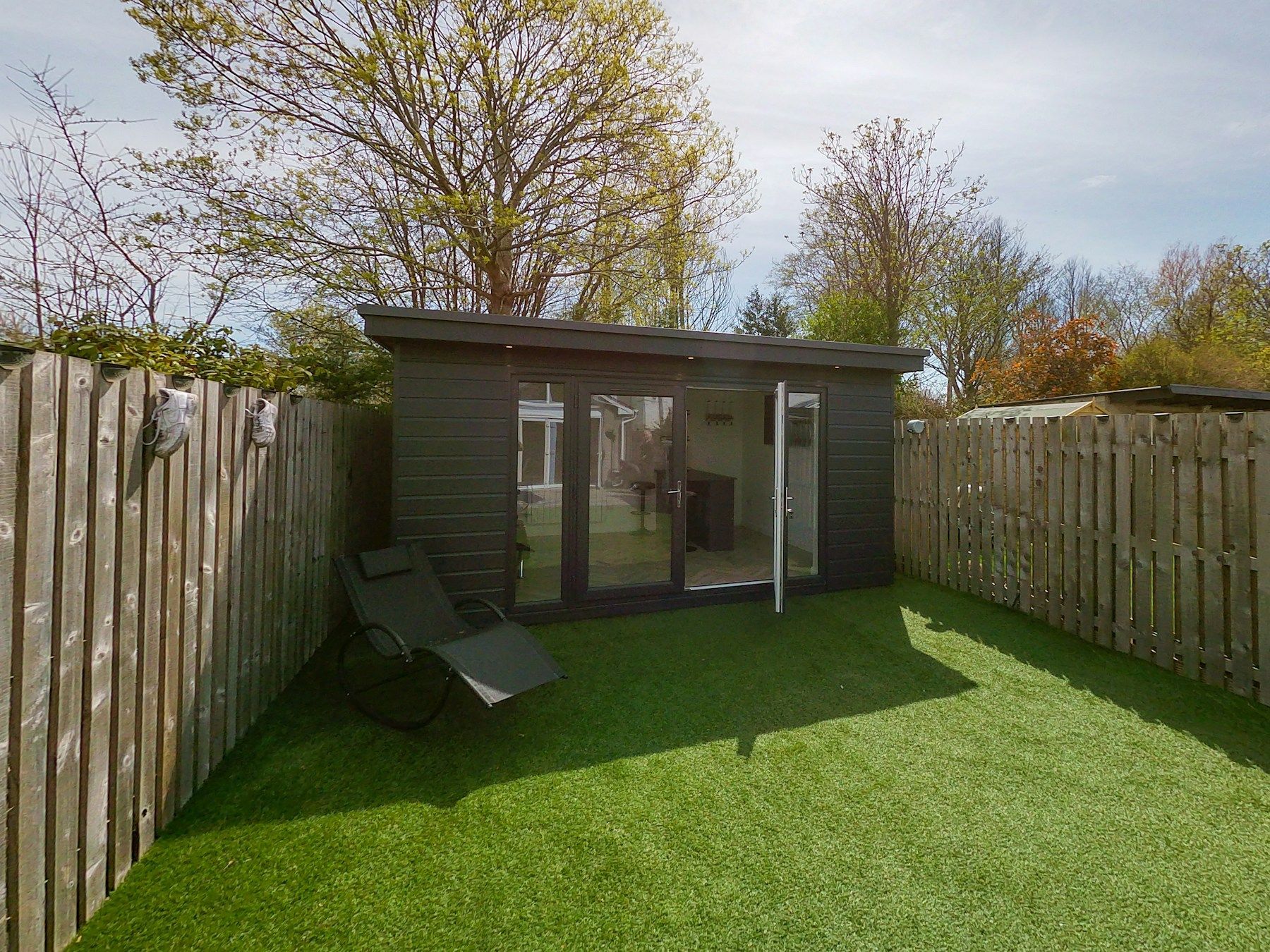
Artificial grass removes mowing and can remain visually consistent throughout the year. However, it needs a correctly drained base and periodic cleaning, especially in gardens used by pets. Leaves and organic debris should be removed so they do not break down within the pile.
Gravel can work for secondary areas or informal paths, provided it has a stable base, effective edging and a suitable membrane where appropriate. It should not be viewed as a material that can simply be spread over existing soil.
Use plants that suit the site
Low-maintenance planting succeeds when plants are placed in conditions that suit them. A plant struggling in deep shade or waterlogged soil will demand more attention and may still fail. Before choosing varieties, consider sunlight, wind exposure, soil moisture and the mature width and height available.
A practical planting scheme may include:
- evergreen shrubs that provide year-round shape;
- reliable perennials planted in groups;
- ground-cover plants to reduce open soil;
- one or two small trees suited to the available space;
- seasonal colour concentrated near the patio or entrance.
Limit the number of varieties and repeat successful plants around the garden. Grouped planting creates a stronger visual effect and makes pruning, feeding and watering more consistent. Applying an appropriate mulch after planting can reduce weeds and help the soil retain moisture.
Be realistic about hedges, fencing and storage
Hedges provide greenery, privacy and habitat, but fast-growing varieties can require frequent cutting. If an existing hedge has become difficult to manage, professional reduction may make it more practical, provided the species and condition allow it. In other locations, a quality fence combined with restrained planting may require less routine work.
Fencing should be structurally sound and treated or finished appropriately for exterior use. Painting every panel a fashionable colour may add an ongoing maintenance task, so consider the long-term implications of the selected finish.
A suitably sized shed keeps tools, cushions and equipment protected and accessible. It needs a stable, level base and enough clearance for maintenance around it. Oversized storage can dominate a small garden, so select dimensions according to what genuinely needs to be stored.
Reduce maintenance through good preparation
Many recurring problems originate below the visible finish. Weeds growing through gravel, puddles on patios, sunken artificial grass and unhealthy turf may all indicate inadequate preparation. Investing in correct excavation, bases, levels and drainage can prevent far more work than a surface treatment applied later.
APCO has more than 30 years of experience creating practical gardens across Lucan, Leixlip, Clondalkin and neighbouring areas. To discuss a low-maintenance layout suited to your home and the way you use your garden, call 01 626 3496 for advice and a quotation.
Recent Posts